






Everyday Spain: The Tapas Culture of Standing, Sipping, and Chatting
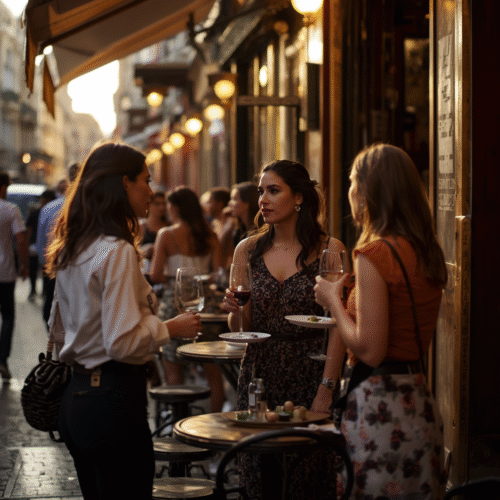
The street corners begin to hum as evening falls. People don’t just walk into restaurants; they pause at the entrance, a glass in one hand and a small plate of food in the other. There is no rush to be seated, nor any pressure for the next course. Someone just finished work, another is just passing by. After a few words, they stay for ten minutes more.
These moments happen almost every day in Spain. It isn’t a formal dinner or a meticulously planned gathering. It is more of a transition between “ending the day” and “starting the night,” where people stand, share, and catch up, letting time stretch on. The portions are small, the pace is light, and the conversation always matters more than the menu.
This lifestyle has a name: Tapas.
From a culinary perspective, however, the true essence of Tapas has never been just about the “form of cooking”. It is a social experience by design.
The Origin of Tapas: It All Started with a Lid

In Spanish, “Tapa” literally means “lid” or “cover.”
The most widely told legend is that early tavern owners used a slice of bread or ham to cover wine glasses, keeping out dust and flies. Over time, this “little thing on top of the wine” began to be taken seriously, eventually evolving into its own culinary form.
Another story traces back to King Alfonso X in the 13th century. It is said that while recovering from an illness, he was prescribed small portions of food accompanied by wine. After his recovery, he decreed that taverns must serve food with wine to prevent drinking on an empty stomach.
Regardless of which origin is closer to the truth, one thing is certain: Tapas were born to accompany wine.
From a business perspective, Tapas is more than a snack; it is a sophisticated table design.
- Socializing Over Cuisine
In Spain, people say “Vamos de Tapas”. It’s meaning “Let’s go for Tapas.” The emphasis isn’t on the “eating,” but on the “going together.” Tapas create an environment where people linger, chat, and interact, rather than focusing solely on a single main course. - A Mobile Dining Rhythm
Authentic Tapas culture rarely stops at one place. It is common to have one drink and a signature dish at one bar, then move to the next. This fluidity turns the evening into a multi-stage experience, allowing each establishment to focus on doing just one or two things exceptionally well. This offers a valuable perspective for business owners. - Standing to Eat and Designing Interaction
In traditional taverns, standing is a choice, not a last resort. A standing posture makes it easier to mingle with strangers and keeps the service rhythm flexible. The bar isn’t just a place to serve food; it’s the social heart of the space.
“The goal isn’t to keep a guest for the whole night, but to ensure they want to return.”

Classic Tapas: The Beauty of Simplicity
The charm of Tapas lies in the fact that they never strive for complexity.
-
Spanish Omelet (Tortilla)
-
Garlic Shrimp (Gambas al Ajillo)
-
Iberico Ham (Jamón Ibérico)
-
Fried Potatoes with Braza Sauce (Patatas Bravas)
What these dishes have in common is their nature: They are simple, straightforward, made for sharing, and born to be paired with wine.
Wine: The Keeper of Rhythm
In such a setting, wine is not the star, yet it is indispensable. It provides the rhythm between dishes and creates the pauses and continuations in conversation. A sip of wine, a bite of food, a moment of talk; and then, you linger a little longer.
Sherry from Southern Spain, with styles ranging from crisp and dry to nutty and aged, fits naturally into this scene. Whether paired with olives, seafood, or simple fried snacks, it never feels out of place.
When discussing Sherry, it is impossible not to mention Osborne. Founded in 1772, it is one of Spain’s oldest family-owned wineries. But to the locals, its presence transcends the wine itself.

Along Spanish highways, you will often see the massive silhouette of a black bull. Originally designed to promote Sherry, it has since become a cultural icon representing the nation’s character: passionate, direct, and slightly uncompromising. When this wine appears at the table, it requires no explanation. It is simply there, forming a part of daily life alongside the food and the people.
Perhaps there is the key: The core of Tapas has never been the small plates themselves. Instead, it answers one fundamental question: How do we make people stay?
For a restaurant, this is more than culture; it is a business model worth considering. It’s not about making the guest feel “fuller,” but about making them willing to stay longer, talk more, and eventually, return.
“Tapas is not just a cuisine. It is a design that invites people to stay.”



 No Alcohol