






From ham and garlic shrimp to paella, reimagine the true essence of Tapas.
Most people’s first encounter with Tapas is usually at a nicely decorated restaurant.
Plates of exquisite snacks, carefully presented, with just the right portions, look like a “collection of small dishes.”
But if you truly walk into Spain, you will slowly discover one thing:
Those Tapas you think are very typical, many are actually not very “Spanish.”
Tapas, is not a type of cuisine.
The most common misconception about Tapas is that it is treated as a “dish name.”
But in Spain, it is closer to a way of dining.
It is not a single dish, but a rhythm: order a few things, share them, eat while chatting, and don’t necessarily sit down.
Sometimes you don’t even have to order anything; you just order a glass of wine, and it comes with a small portion of food.
 The point was never what you eat, but how to start an evening.
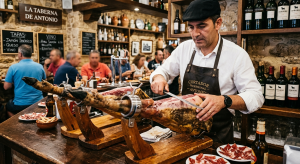
Why is ham always found in Tapas?
If you observe the bars in Spain, there is one thing rarely missing:
cured ham (Jamón).
But there is one thing many people don’t know:
👉 On local bar counters, most of it is actually not Ibérico ham, but white pig ham (Jamón Serrano).
What we are familiar with is the flavorful and expensive Ibérico ham, but what actually supports the daily Tapas scene is the more common and accessible Serrano.
The reason is quite simple. First, it requires no cooking; it can be served as soon as it’s sliced, perfectly meeting the immediacy of Tapas.Second, its high salinity and moderate fat content naturally bring out the flavors of the wine, especially Sherry.
Finally, unlike hot food that needs to be eaten immediately, it can accompany you through the entire conversation.
👉 So it is a classic not because it is expensive, but because it is perfectly suited for this scene.
Why can a plate of garlic shrimp represent a culinary culture?
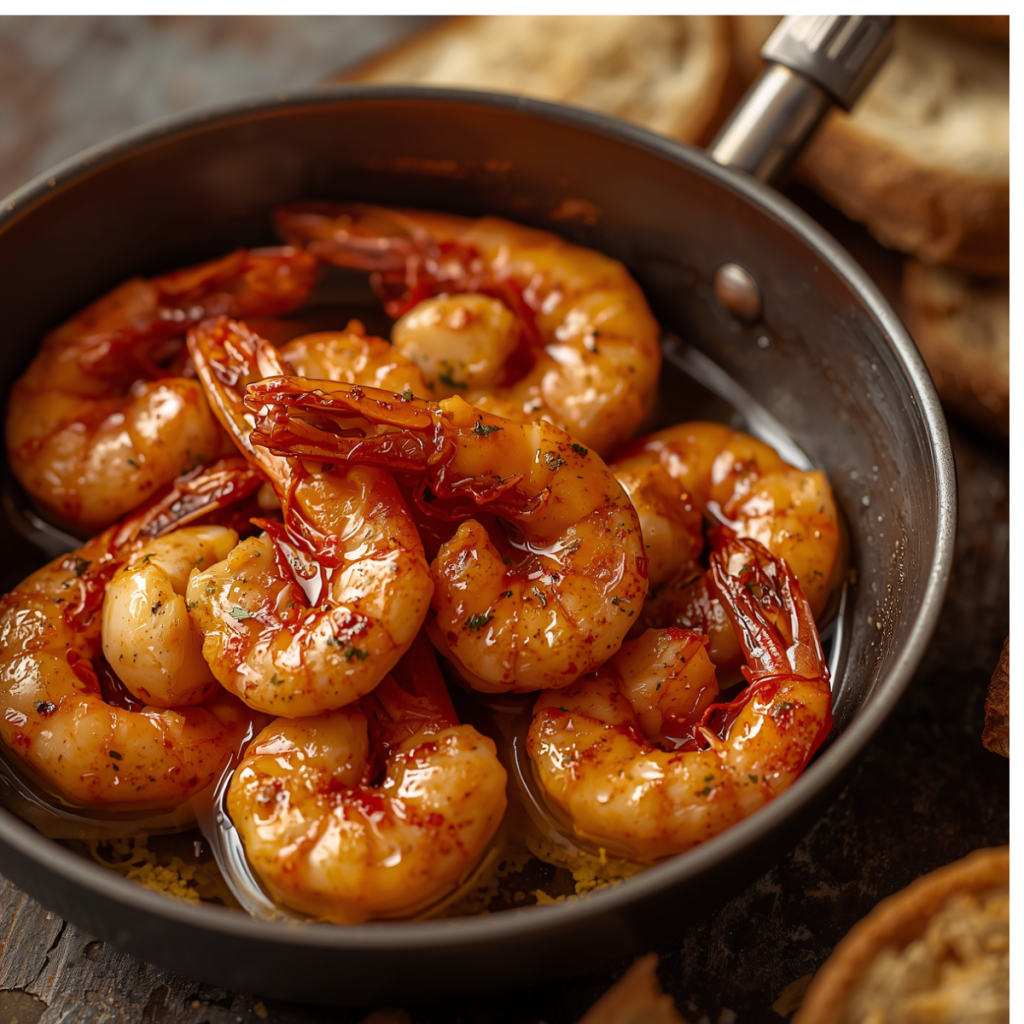
Gambas al ajillo is almost everyone’s representation of Tapas.
But the key to it is actually not the garlic or the shrimp, but a protagonist that is easily overlooked: olive oil.
Spain is one of the world’s largest producers of olive oil, and high-quality Extra Virgin Olive Oil (EVOO) is a perennial winner in international competitions.
This allows this seemingly simple dish to be built upon a very high standard.
Olive oil is not just a cooking medium, but the core of the flavor, carrying the overall aroma of garlic, chili, and shrimp; the fewer the ingredients, the higher the requirements, as the quality of the oil and the freshness of the shrimp will be completely magnified.When the dish is served, the oil remains on the plate, the bread can continue to be dipped, and both the flavor and the conversation can continue.
👉 So this dish is a classic not because it is complex, but because it brings the essence of “ingredients” directly to the table.
What about Paella? Is it considered Tapas?
Many people group Paella and Tapas together, but strictly speaking, it is not Tapas.
Paella is a main course; it requires time to prepare and is usually shared from a large pan, rather than being a small, quick-to-serve portion.
But why do they often appear together?
Because in international or restaurant contexts, they are often collectively referred to as “Spanish cuisine,” which is actually a curated version.
It’s just like how sushi and ramen might not always appear on the same daily dining table in Japan, but they are often found on the same menu overseas.
Tapas, in fact, has no single form.
If you travel to different regions of Spain, Tapas begins to change.
In the Basque Country in the north, you will see more refined Pintxos, which are small, bite-sized, and often secured with a toothpick; in Andalusia in the south, it is more casual, with larger portions, and closer to daily life; in Madrid, it is a mix of tradition and modernity, with the most variety.
👉 In other words, Tapas is not a cuisine, but a framework.
It is actually a hybrid culture.
Southern Spain has long been influenced by Moorish (North African/Arab) culture, and these traces still remain in Tapas, such as the use of spices, the combination of sweet and salty, and the frying techniques.
👉 Therefore, Tapas is not a “pure tradition,” but a lifestyle accumulated and blended over time.
Finally, what really matters is not the food.
If you strip away all the details, the most important things about Tapas are not the ham, garlic shrimp, or any specific dish, but three things :
- Small portions, so you can order a variety.
- A slow pace, so the evening doesn’t end all at once.
- Free-form, so you can stand, move around, and hop from place to place.
👉 Its essence is: letting an evening not have to end so quickly.
🍽 A small suggestion for your table.
If you want to try approaching Tapas in a more authentic way, you can arrange it like this :
- A room-temperature item (such as ham or cheese).
- A hot dish (such as garlic shrimp or simple pan-fried items).
- A basket of bread (to extend the flavors).
- A bottle of easy-drinking wine to sip slowly.
👉 You don’t need a complete menu; the point is to extend the rhythm, not to end it.
Many times, we think we are replicating a culture, when in fact we are only replicating its form.
But for something like Tapas, what truly remains is never the menu, but the reason that makes people want to stay a little longer.



 No Alcohol